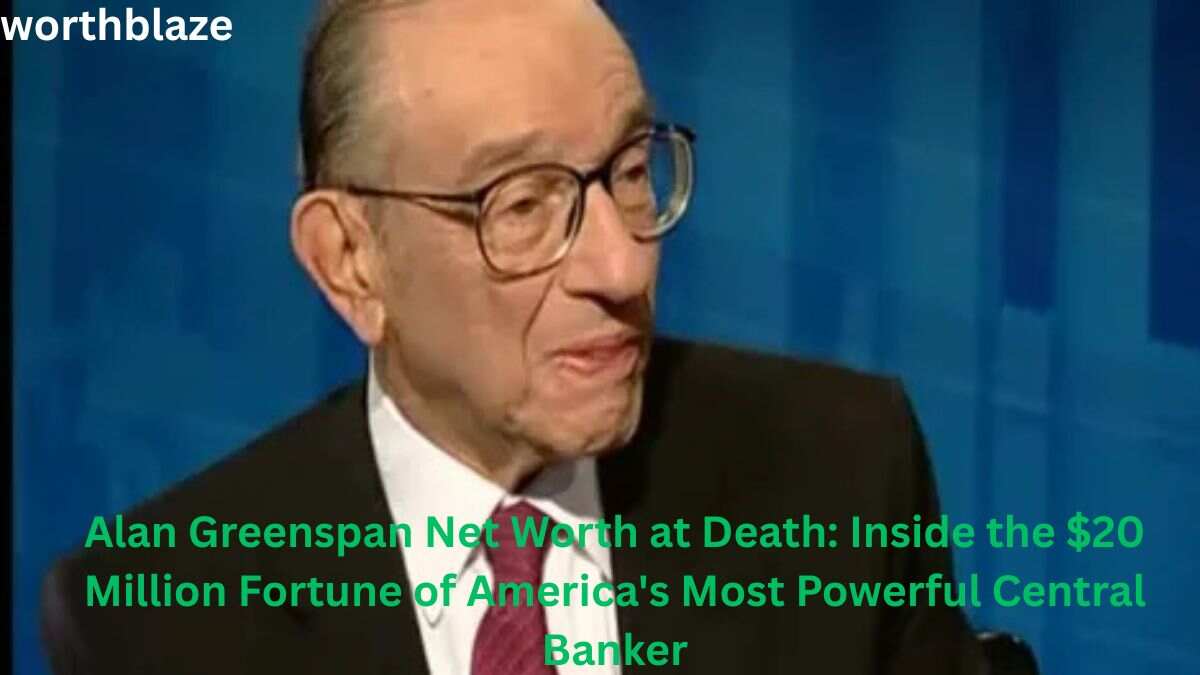
At the time of his passing on June 22, 2026, Alan Greenspan net worth was estimated to be $20 million — a sum that may seem relatively modest for an individual who served as the most scrutinized economic policymaker globally for nearly two decades. The former Chairman of the Federal Reserve passed away at his residence in Washington, D.C., at the age of 100 due to complications from Parkinson’s disease, with his wife of 29 years, NBC News journalist Andrea Mitchell, by his side.
For 18 and a half years, Greenspan led the institution responsible for determining the price of money in the world’s largest economy. His government salary reached a peak of $180,000 annually. This narrative outlines how he amassed a $20 million fortune on a bureaucrat’s salary — and what this figure reveals about his life, career, and the intricate legacy he left behind.
Who Was Alan Greenspan?
Alan Greenspan was an American economist, author, and public servant who served as the 13th Chairman of the Federal Reserve from August 1987 through January 2006 — a tenure of nearly 19 years that made him the second-longest-serving Fed chair in history, behind only William McChesney Martin. Appointed by President Ronald Reagan, he was subsequently reappointed by George H.W. Bush, Bill Clinton, and George W. Bush, serving across four administrations and surviving political transitions that ended most other Washington careers. At his peak, he was nicknamed “The Maestro” for helping guide the U.S. economy through one of its longest peacetime expansions. After the 2008 financial crisis, that same legacy grew far more complicated.
Quick Facts About Alan Greenspan
| Field | Details |
|---|---|
| Full Name | Alan Greenspan |
| Date of Birth | March 6, 1926 |
| Birthplace | Washington Heights, New York City |
| Profession | Economist, Former Federal Reserve Chairman |
| Fed Chairmanship | 1987 – 2006 |
| Net Worth (estimated) | ~$20 Million |
| Spouse | Andrea Mitchell |
Alan Greenspan’s Early Life — Washington Heights, Jazz, and the Road to Economics
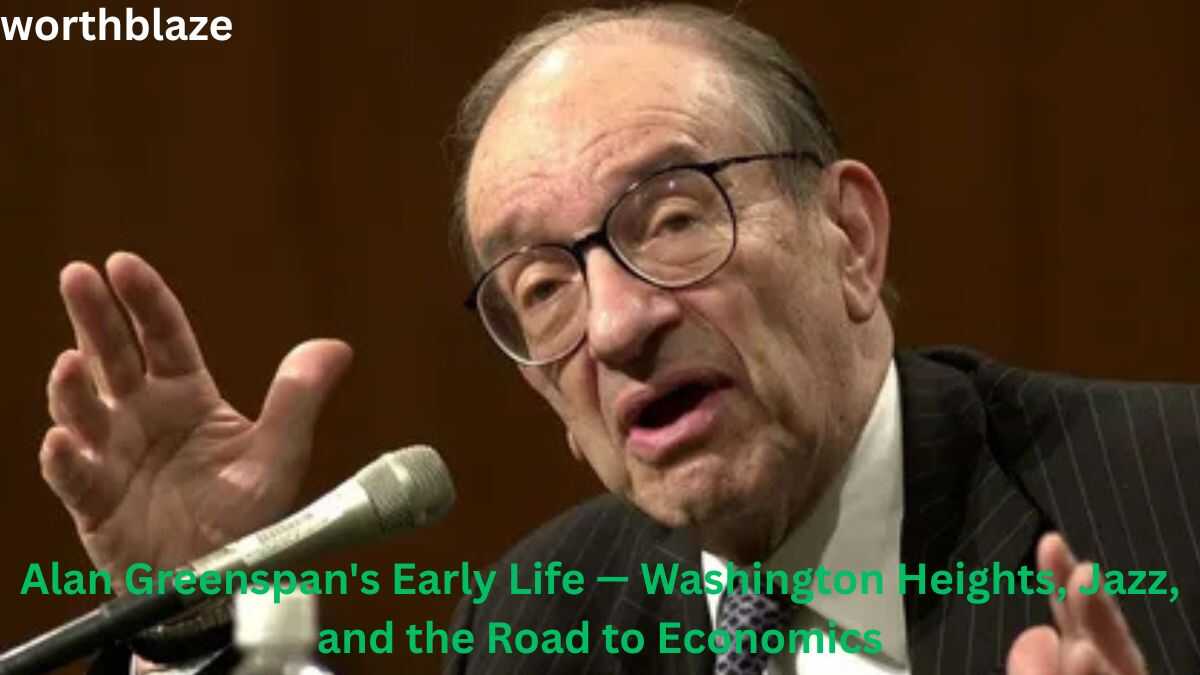
Alan Greenspan was born on March 6, 1926, in the Washington Heights neighborhood of Manhattan. His parents, Herbert and Rose Greenspan, divorced while he was still a child, and he was raised largely by his mother. His father worked as a stockbroker and market analyst — an early household connection to financial markets that may have planted early seeds, even though Greenspan’s first serious passion was music rather than economics.
He attended George Washington High School, graduating in 1943, then enrolled at the Juilliard School to study clarinet. He also played saxophone and performed with a swing band. Between rehearsals and performances, Greenspan found himself drawn repeatedly to books about business, finance, and markets, eventually concluding that economics had a stronger hold on him than music ever would.
He enrolled at New York University’s Stern School of Business, graduating summa cum laude with a bachelor’s degree in economics in 1948. A master’s degree from NYU followed in 1950. He briefly pursued advanced doctoral work at Columbia University under Arthur Burns — a future Fed chairman himself — before withdrawing to keep up with growing demands at his consulting firm. He ultimately returned to NYU and completed his doctorate in economics in 1977, roughly three decades after most students would have finished.
Alan Greenspan Career Timeline
| Year | Milestone |
|---|---|
| 1926 | Born March 6 in Washington Heights, New York City |
| 1948 | Graduates NYU Stern, B.A. Economics |
| 1950 | Earns M.A. Economics from NYU |
| 1955 | Becomes president of Townsend-Greenspan & Co. |
| 1974–1977 | Chair, Council of Economic Advisers |
| 1987–2006 | Federal Reserve Chairman |
| 1996 | “Irrational exuberance” speech |
| 2006 | Retires from Federal Reserve |
| 2007 | Publishes *The Age of Turbulence* |
| 2018 | Publishes *Capitalism in America* |
Alan Greenspan Net Worth at Death — The $20 Million Story
Celebrity Net Worth and multiple 2026 sources consistently place Greenspan’s net worth at $20 million at the time of his death. That number is striking for what it represents on both ends. It is a substantial sum for someone who spent the most powerful years of his career drawing a government salary. It is a comparatively modest figure for a man whose public statements could send global bond markets into a frenzy within seconds. The gap between the economic power Greenspan wielded and the personal wealth he accumulated is one of the more unusual financial contrasts in modern public life.
Why $20 Million and Not More?
The answer to this issue comes from how Greenspan managed his finances while serving in government. During his time as Federal Reserve Chairman, he invested mainly in short-term U.S. Treasury bills. This helped him avoid any conflict of interest and showed his focus on staying independent rather than making personal profit.
His last public financial disclosure in 2004, when he was still chairman, estimated his personal wealth at between $3 million and $6.5 million. When he joined the Federal Reserve in 1987, he was already a millionaire, having earned money through private consulting work. However, during his time in office, he kept his financial life simple and low-profile.
The real financial acceleration came only after he stepped down from the Fed in January 2006. Consulting fees from major financial institutions, speaking engagements at global conferences, and one of the largest nonfiction book advances of its era pushed his net worth substantially higher in the post-government years.
How Alan Greenspan Made His Money
Townsend-Greenspan & Co. — Three Decades of Economic Forecasting
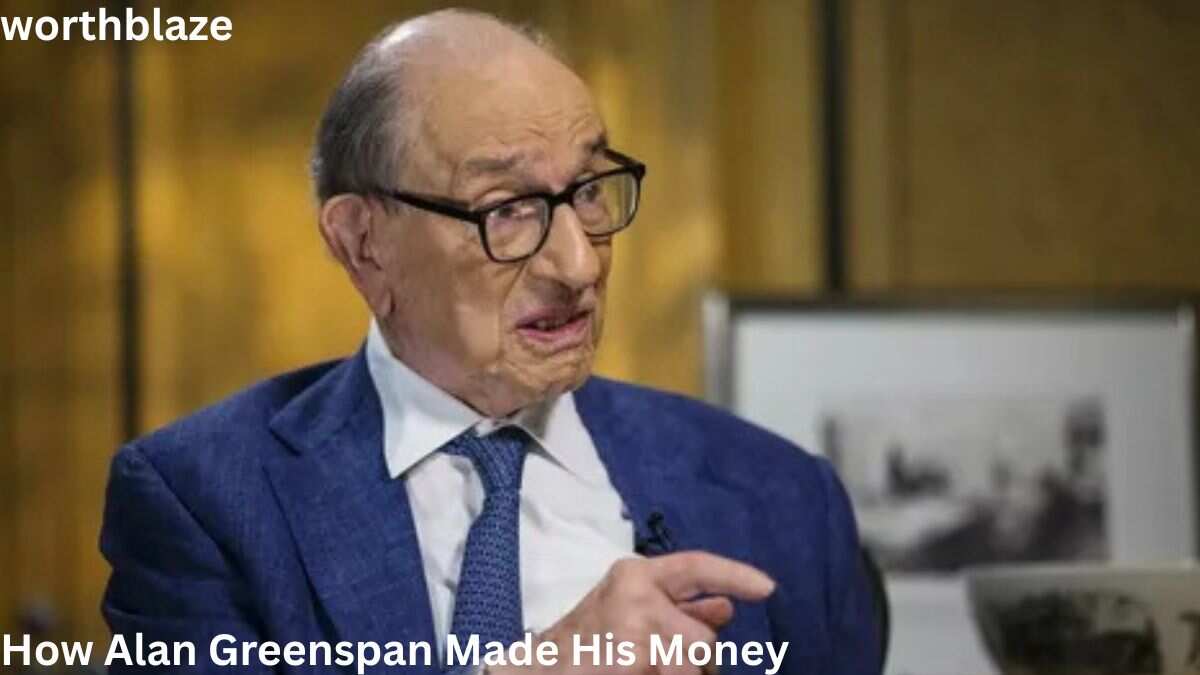
Before the Fed chairmanship, Greenspan spent more than 30 years building and running Townsend-Greenspan & Co., the economic consulting firm he joined in 1955 and led as president and chairman until heading to Washington in 1987. The firm focused on economic forecasting, with Greenspan developing a specialty in tracking detailed industrial and business data to understand where the broader economy was heading — not grand macroeconomic theory, but granular, on-the-ground analysis of how companies, consumers, and investors were actually behaving.
Corporate clients included major American businesses, and Greenspan personally held board positions at companies including J.P. Morgan & Co., Automatic Data Processing, General Foods, Alcoa, and Mobil Corporation. His 2004 financial disclosure suggested that by the final years of his Fed tenure, those decades of private sector work had built a net worth in the $3 to $6.5 million range — enough to be genuinely comfortable, but well short of the fortunes his peers in the private financial world had accumulated.
Greenspan Associates LLC — Cashing In After the Fed
After retiring in January 2006, Greenspan wasted little time returning to the private sector. He founded Greenspan Associates LLC, a consulting firm through which he made his expertise available to corporations and financial institutions worldwide. Pacific Investment Management Company, known as PIMCO, brought him on as a special consultant. He advised institutional clients at Deutsche Bank. He later joined Paulson & Co. — the hedge fund that made billions betting against the housing market before the 2008 crisis — as a formal adviser.
None of the specific contract values were ever disclosed publicly, but the client list speaks to the level of compensation involved. These institutions were not hiring Greenspan for standard economic commentary. They were paying for direct access to the person who had spent nearly two decades setting the monetary policy that affected every investment they made.
The Age of Turbulence — An $8.5 Million Book Advance
The largest single payday of Greenspan’s post-Fed life came from publishing. His 2007 memoir, The Age of Turbulence: Adventures in a New World, earned him an $8.5 million advance from Penguin Press — one of the biggest non-fiction book advances of that era. In contrast, his successor, Ben Bernanke, was compensated approximately $1 million for his memoir several years later. The book became a bestseller and landed at an especially charged moment, just as the early warning signs of the housing crisis were beginning to surface.
Greenspan also published a second book in 2018, Capitalism in America: A History, co-authored with economist Adrian Wooldridge. He wrote much of his memoir by hand while soaking in the bathtub — a habit he developed after injuring his back in 1971 — a detail that became one of the more memorable personal anecdotes from an otherwise technically minded public figure.
Speaking Fees
Throughout his post-Fed years, Greenspan remained one of the most sought-after voices at global economic conferences and institutional gatherings. Speaking fees from banks, investment firms, corporations, and academic institutions added steadily to his income even as he reduced his public profile in his later decades.
The Federal Reserve Years — Nearly Two Decades at the Center of Global Finance
Greenspan faced his first significant challenge almost immediately after assuming office. On October 19, 1987 — merely weeks into his chairmanship — the Dow Jones Industrial Average plummeted by over 22% in a single day, marking the largest one-day percentage decline in the index’s history. Greenspan acted swiftly, indicating that the Federal Reserve would ensure liquidity in the financial system and reduce interest rates. His actions played a crucial role in averting a broader banking crisis and established a precedent that characterized his entire tenure: the Federal Reserve under Greenspan would take decisive action when markets experienced severe stress. This approach became known in financial circles as the “Greenspan put.”
Throughout the 1990s, he emerged as one of the most prominent figures in American economic affairs. He supported President Clinton’s initiative for deficit reduction in 1993, aided the country during the Mexican peso crisis, the Asian financial crisis, the Russian debt default, the failure of Long-Term Capital Management, the dot-com boom and its subsequent collapse, along with the economic instability that ensued after the events of September 11. In 1996, he delivered his most renowned public caution — a speech that questioned whether “irrational exuberance” was driving asset prices beyond what economic fundamentals could support. This phrase quickly became a financial catchphrase and has been cited thousands of times since.
Greenspan also gained notoriety for his intentionally ambiguous communication style, referred to in Washington as “Fedspeak.” Market participants devoted considerable effort to deciphering his congressional testimonies and public addresses, interpreting every word as a potential indicator of interest rate trends. The prevailing joke in Washington was that if you believed you understood Greenspan’s remarks, you likely did not.
The 2008 Financial Crisis — Where the Legacy Got Complicated
Greenspan’s reputation absorbed its most serious damage after he left the Federal Reserve. The housing market collapse and the broader financial crisis of 2007 and 2008 led many economists, lawmakers, and commentators to revisit the decisions made during his tenure.
Critics pointed to two main issues. First, his decision to keep interest rates unusually low in the early 2000s, which many economists argued helped inflate the housing bubble. Secondly, he consistently opposed tighter rules on financial derivatives and complex mortgage-backed securities. This view came from his belief that financial markets were better at handling their own risks than government regulators.
In 2008, testifying before Congress, Greenspan acknowledged that the crisis had revealed a flaw in that belief — specifically, his assumption that financial firms would act rationally to protect their shareholders and balance sheets. The bipartisan Financial Crisis Inquiry Commission concluded in 2011 that the crisis was triggered in part by Greenspan’s failure to discourage the growth of subprime lending and his advocacy for financial deregulation. Greenspan defended much of his record in subsequent years, but never fully walked away from the 2008 concession.
Personal Life — Joan Mitchell, Barbara Walters, and Andrea Mitchell
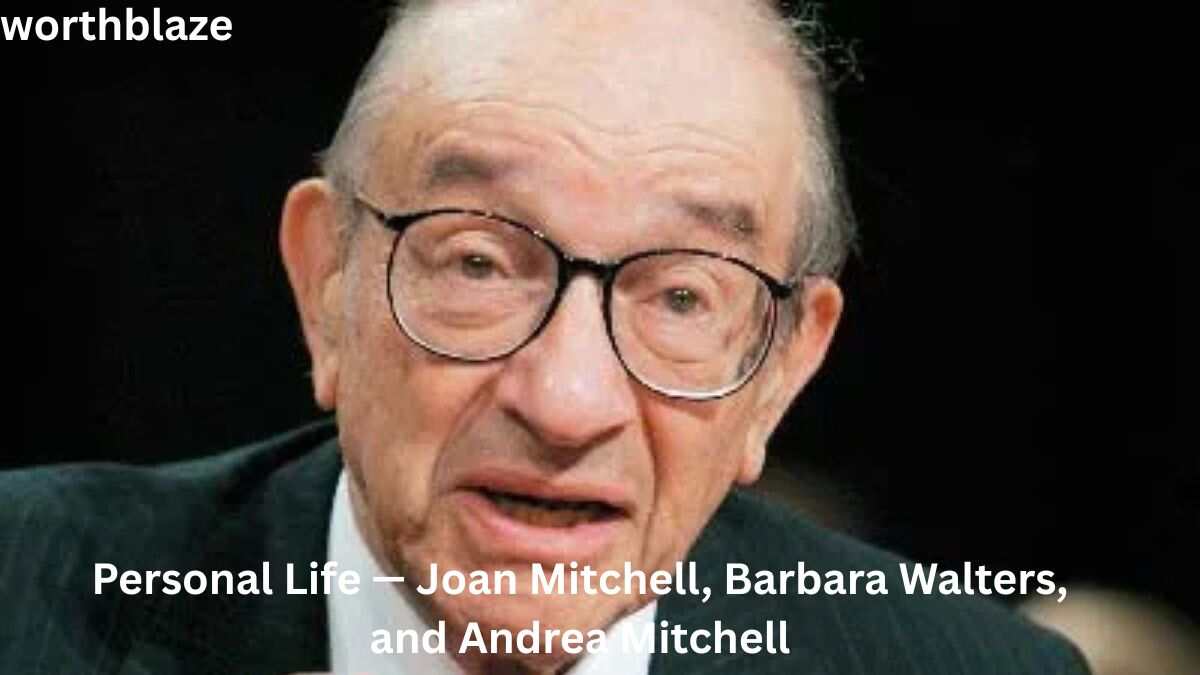
Greenspan’s romantic history had three distinct chapters. He married Joan Mitchell — a painter who later became a significant figure in American abstract expressionist art — in October 1952. The marriage was annulled ten months later. Joan Mitchell went on to a celebrated art career before her death in Paris in 1992. Greenspan and Rand shared overlapping intellectual circles in the early 1950s, and Rand’s philosophy of laissez-faire capitalism left a deep impression on Greenspan’s worldview — an influence he acknowledged directly in his 2007 memoir.
In the 1970s, Greenspan had an on-and-off relationship with journalist Barbara Walters, which both later described as non-exclusive. His initial meeting with Andrea Mitchell occurred in 1983 during an interview regarding Social Security reform, and they subsequently had their first date on December 28, 1984. After nearly 13 years together, Greenspan proposed to Mitchell on Christmas morning in 1996, and they married on April 6, 1997, at the Inn at Little Washington in Virginia, with Supreme Court Justice Ruth Bader Ginsburg officiating the ceremony. Guests included Henry Kissinger, David Brinkley, and Katharine Graham.
At the time of his death, Greenspan and Mitchell had been together for 42 years and married for 29. Mitchell stepped down from her longtime MSNBC program, Andrea Mitchell Reports, in 2025 after nearly 17 years as anchor, partly to spend more time reporting from Washington and with her husband. Their home — a $2.7 million property in the Kent neighborhood of Washington, D.C. — was where Greenspan spent most of his final years. He had no children from any of his relationships.
Mitchell’s tribute described Greenspan as “a giant of a man who helped shape the U.S. economy for decades under presidents of both parties, but was always honest in acknowledging his mistakes.” She added that he had “irrational exuberance” — borrowing his own famous phrase — for baseball, the Washington Commanders, tennis, golf, and jazz. She wrote that being his life partner was “the joy of my life.”
Awards and Recognition
| Award | Year |
|---|---|
| Fellow, American Statistical Association | 1989 |
| Commander of the French Legion of Honor | 2000 |
| Knight Commander of the Order of the British Empire | 2002 |
| Dwight D. Eisenhower Medal for Leadership and Service | 2004 |
| Presidential Medal of Freedom | 2005 |
| Thomas Jefferson Foundation Medal in Citizen Leadership | 2007 |
| Eugene J. Keogh Award for Distinguished Public Service | 2012 |
Ayn Rand and the Free-Market Philosophy That Shaped — and Later Haunted — His Record
Greenspan became part of Ayn Rand’s intellectual circle in the early 1950s and remained close to her until her death in 1982. Rand’s philosophy — a defense of laissez-faire capitalism, rational self-interest, and skepticism of government market intervention — shaped his worldview in ways that stayed with him throughout his career. In his 2007 memoir, he credited her as a profound intellectual influence.
While he evolved into a pragmatic central banker rather than a purely ideological figure, his belief that markets were generally better at managing risk than regulators proved to be a consistent thread — and later, the specific belief that critics most directly connected to the regulatory environment preceding the 2008 crisis.
Alan Greenspan vs Other Fed Chairs — Wealth Comparison
| Fed Chair | Net Worth (approx.) | Years at Fed | Notable For |
|---|---|---|---|
| Alan Greenspan | ~$20 Million (estimated) | 1987–2006 (18.5 years) | “The Maestro”, long tenure during major market cycles |
| Ben Bernanke | ~$2 Million (estimated) | 2006–2014 | Led Fed during 2008 financial crisis and QE policy |
| Janet Yellen | ~$20 Million (estimated) | 2014–2018 | First female Fed Chair; later U.S. Treasury Secretary |
| Jerome Powell | High net worth (private estimates vary) | 2018–Present | COVID-era monetary policy and inflation control cycle |
What Alan Greenspan Left Behind
Alan Greenspan is survived by Andrea Mitchell. He had no children. The Federal Reserve issued a formal statement marking his death, crediting him with bringing “rigorous analytical discipline to monetary policymaking” and noting that under his leadership, the Fed achieved a sustained era of price stability. Former New York Mayor Michael Bloomberg wrote that the arc of Greenspan’s career “reflected — and shaped — the story of modern finance.”
Also read: Kyle Busch Net Worth
Conclusion
Alan Greenspan’s estimated $20 million net worth at the time of his death on June 22, 2026, reflects a career focused more on public service than personal wealth. He served for almost 20 years as one of the most powerful economic policymakers globally, even though his income during that time came from a fairly modest government salary. During his time at the Federal Reserve, he kept his investments simple to avoid any conflict of interest and protect the independence of his role.
Most of his financial growth came after leaving office, through consulting work, speaking engagements, and a book deal that earned far more than typical lifetime earnings for economists. He lived to the age of 100 and played a major role in shaping global economic policy, though his legacy remains widely debated.
Frequently Asked Questions
What was Alan Greenspan’s net worth at the time of his death?
Alan Greenspan’s net worth at the time of his death on June 22, 2026, was estimated at $20 million, built primarily through post-Fed consulting work, speaking fees, and an $8.5 million book advance for his 2007 memoir.
How did Alan Greenspan die?
Greenspan died on June 22, 2026, at his Washington, D.C. home from complications of Parkinson’s disease. He was 100 years old. His wife, NBC News journalist Andrea Mitchell, confirmed his death.
How much did Alan Greenspan earn as Federal Reserve Chairman?
Greenspan’s peak annual salary as Fed Chairman was approximately $180,000. He served from August 1987 through January 2006 under four presidents.
Who was Alan Greenspan married to?
Greenspan was married to Andrea Mitchell, the veteran NBC News journalist, from April 1997 until his death in June 2026. He was briefly married to artist Joan Mitchell in 1952, but the marriage was annulled after about ten months. He had no children.
What was Alan Greenspan’s most famous phrase?
In a 1996 speech, Greenspan cautioned about what he called “irrational exuberance” in financial markets. The phrase quickly became widely known and is still often used by analysts when talking about market bubbles or excessive speculation.
Leave a Reply